History

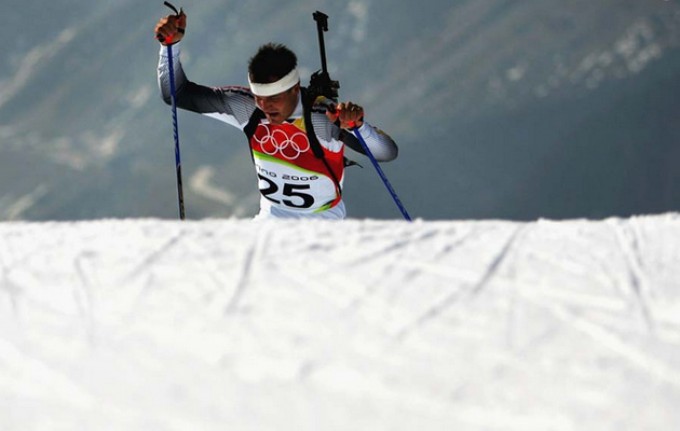
Biathlon combines the power and aggression of cross-country skiing with the precision and calm of marksmanship.

Roots in survival
The word biathlon stems from the Greek word for two contests, and is today seen as the joining of two sports; skiing and shooting. Biathlon has its roots in survival skills practised in the snow-covered forests of Scandinavia, where people hunted on skis with rifles slung over their shoulders.

Standardising the rules
In 1948, the Union Internationale de Pentathlon Moderne et Biathlon (UIPMB) was founded, to standardise the rules for biathlon and pentathlon. In 1993, the biathlon branch of the UIPMB created the International Biathlon Union (IBU), which officially separated from the UIPMB in 1998.

First competition
Biathlon-type events in Scandinavia are known to have been held as early as the 18th century. The first modern biathlon probably occurred in 1912 when the Norwegian military organised the Forvarsrennet in Oslo. An annual event, it consisted initially of a 17km cross-country ski race with two-minute penalties incurred by misses in the shooting part of the competition.

Olympic history
Biathlon was staged at the 1948 Winter Games in St Moritz as a demonstration sport. At the time, it combined cross-country and downhill skiing, shooting, fencing and equestrian events. Inspired by modern pentathlon, it was the first attempt to introduce a multi-disciplinary event. It was included on the Olympic programme in Squaw Valley in 1960. Women’s biathlon was organised as a medal sport in Albertville in 1992.

Until the 1976 Games in Innsbruck, the events comprised an individual race and a relay. In Lake Placid in 1980, a second individual event was introduced.

In Salt Lake City in 2002, a 12.5km pursuit event was added for men and 10km for women. From Turin in 2006, a new mass-start event was introduced for both men and women. This brings together the 30 best athletes from the World Cup.

Source: olympic.org

Equipment

Arm sling
Used to stabilise the rifle while shooting.

Boots
These are more rigid and have more ankle support than classic technique boots because they are subject to considerable lateral pressure.

Clip
Also called a magazine. Used to hold five .22-calibre rifle cartridges. Up to four clips can be stored in the rifle stock while the athlete skis the course. At the range, the clips are taken from the stock and inserted into the rifle as needed.

Fore sight
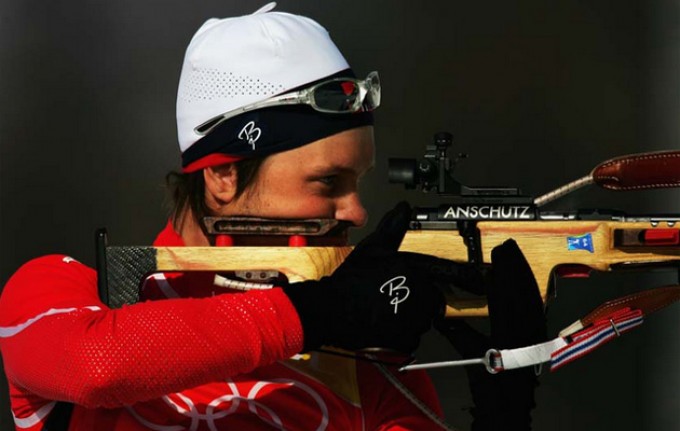
A marker at the end of the barrel that aids in aligning a shot with the target.

Harness
Used to carry the rifle on the athlete’s back while skiing.

Magazine
Holds clips. Each clip holds five .22-calibre rifle cartridges; up to four clips can be stored in the rifle stock while the athlete skis the course.

Rear sight
A clear cylinder that magnifies the target (to align the target correctly, the fore sight should be perfectly centred in the rear sight; generally, one eye is shut to eliminate distractions).

Ski poles
Poles are generally longer and stiffer than those used for classic technique and extend to the chin or mouth of the skier; baskets and tips have the same design as classic technique poles.

Skis and wax
Freestyle technique skis are shorter, nominally stiffer and have tips that curve less than classic technique skis. Glide wax is applied to the entire under surface.

Ski suit
Reduces wind impact and resistance.

Target
The size of the target varies according to the position (standing or prone) of the contestant. If a contestant hits a target that is coloured black, a white disc slides across it, indicating a successful shot.

Clicks
Slight adjustments for wind and sun angles made by moving the rear apertures of the rifle sight in different directions. The amount of change is measured by clicks turned. The coach at the range may assist the athletes arriving to shoot by calling out sight corrections such as, “Three clicks to the right”.

Declared rounds
In relay events, eight bullets are carried in each clip. Upon entering the range, the biathlete must deposit the extra three rounds in a cup at his shooting point before beginning to shoot. The five rounds from the clip are used to hit five targets. If more rounds are needed, the extra declared rounds may then be hand-loaded one at a time and used.

Source: olympic.org

Glossary

Penalty loop
Loop of 150m that must be skied when targets are missed during the sprint, pursuit and relay events. One loop is skied for every target missed and takes anywhere from 20 to 30 seconds. No penalty loops are used in the individual events. Instead, a one-minute penalty is added for each miss.

Shoot clean
Hitting all five targets during one shooting stage.

Skate
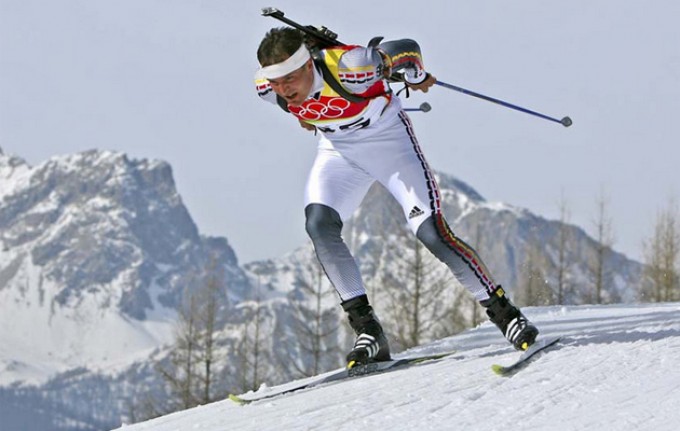
The technique used while skiing. Longer poles are used to drive skiers forward, gliding out onto the right leg and then back to the left leg. The skier moves in a right-to-left direction as opposed to being propelled straight down the trail. No ski tracks are used.

Skiing styles
Classic: a diagonal style with a transverse stepping technique required on uphill sections (skating is not permitted); and freestyle: there are various techniques used, but a skating movement is the most common.

Zero
Time spent before the race shooting at paper targets to align the rifle sights. When zeroed, the rifle is accurate for the particular wind and light conditions on the range at that time.

Source: olympic.org