Air resistance
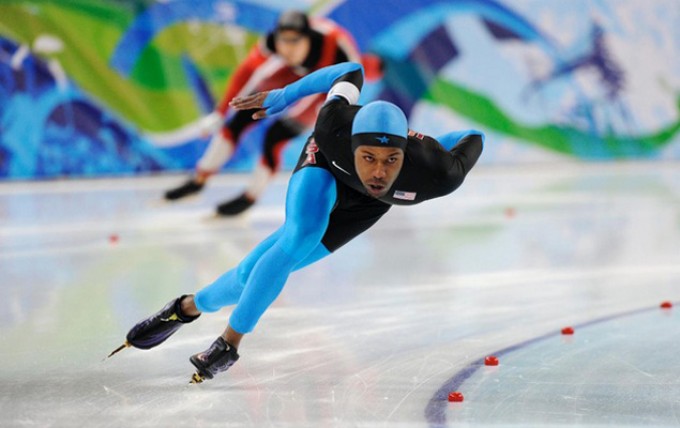
In the men”s 500m race, air resistance is equivalent to a force of 5kg which accounts for nearly 70% of the physical resistance to overcome. Friction between skates and ice accounts for the remaining 30%
Gravitational force
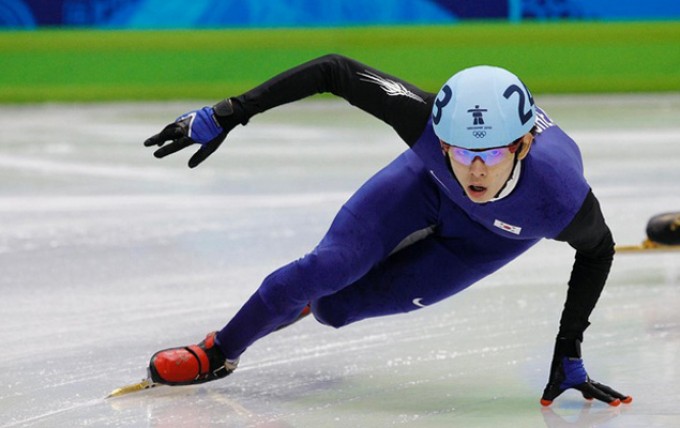
Going around a curve, the skater is pushed outward at a force of 60kg in the inner lane and 52kg in the outer lane. To counteract this centrifugal force, the skater leans 45° when in the inner lane and 49° in the outer. This results in a gravitational force equivalence of 90kg on one leg in the inner lane and 76.5kg in the outer.
Heat
All races consist of one heat except the 500m, in which there are two heats with competitors taking it in turns to start in the outside lane.
International Skating Union (ISU)
The International Skating Union (ISU) is recognised by the International Olympic Committee as speed skating”s official governing body. The ISU makes the rules, trains and certifies judges, and determines how international figure skating competitions, including the Olympics, are run.
Lane
The athletes change corridors each lap on the back straight. The skater passing from the outside lane to the inside lane has priority.
Markers
Indicate the line the skater must follow. An athlete can shift them and change lanes, as long as the distance skated is not reduced.
Skating pattern
The skater propels forward by using a combination of movements veering to and from the trajectory taken by the body on a 1mm wide blade.
Start
A staggered start for all races except the 500m race. Competitors line up 2m from the start line. When the judge calls them forward they approach the line, and begin skating when the starting pistol is fired. Two false starts lead to disqualification.