History

This sport, which has a long Olympic history, combines ski jumping and cross country skiing

Norwegian origins
For centuries in the snow-covered North, skis were required to chase game and gather firewood in winter time. With long distances between the small, isolated communities and hard, snowy winters, skiing also became important as means of keeping in social contact. The word “ski” is a Norwegian word which comes from the Old Norse word “skid”, a split length of wood.

Holmenkollen ski festival
The famous Holmenkollen ski festival started in 1892 where the main attraction was the Nordic combined event. The festival proved popular and soon attracted skiers from Sweden and other neighbouring countries. In fact King Olav V of Norway was himself an able jumper and competed in the Holmenkollen Ski Festival in the 1920s.

Nordic dominance
Nordic combined individual events have featured in every Games since the first Olympic Winter Games in Chamonix in 1924. Unsurprisingly, the sport has been dominated by the Norwegians, supported by the Finns. Indeed, it was not until 1960 that the Nordic grip on Olympic triumphs in this discipline was finally broken when West German Georg Thoma won the gold medal at Squaw Valley in 1960.

Source: olympic.org

Equipment

Bindings
The binding must be mounted parallel to the run-direction. The binding must be placed in such a way that a maximum 57% of the entire ski length is used as the front part.

Boots
High-backed, flexible yet firm boots with a low cut at the front. They are designed to allow the skier to lean forward during flight.

Connection cord
Part of the binding; a cord that attaches the ski to the boot and prevents the wobbling of skis during flight.

Ski Jumping suit
All portions of the ski jumping suit must be made of the same material and must show a certain air permeability. The size of the suit must conform to the body shape in an upright position with certain tolerances.

Jumping skis
Jumping skis are manufactured especially for use on ski jumping hills. Skis with a length of a maximum 146% of the total body height of the competitor may be used. The curvature and shape of the skis is restricted by certain geometric features.

Poles
Long and straight, often reaching up as high as a competitor’s chin, with a specially shaped basket designed to allow skiers to push hard and evacuate snow.

Skis
Narrower and lighter than those used in Alpine skiing. They have long, curved ends and rise up slightly in the middle. They can be up to 2m long.

Suit
Uses stretch fabric hugging the body, similar to a runner’s training clothing. Woollies and thick socks are definitely no longer fashionable.

Wax
Glide wax is crucial and determined by snow and weather conditions.

Source: olympic.org

Glossary

Classic technique (cross-country)
The traditional ski racing technique. Athletes use a diagonal stride in which both skis stay parallel to each other.

Free technique (cross-country)
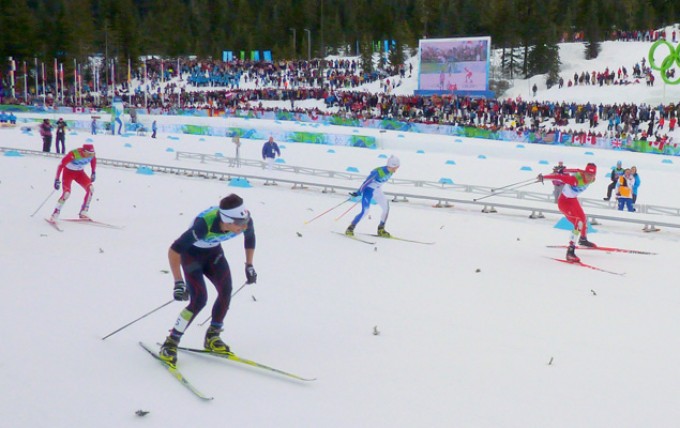
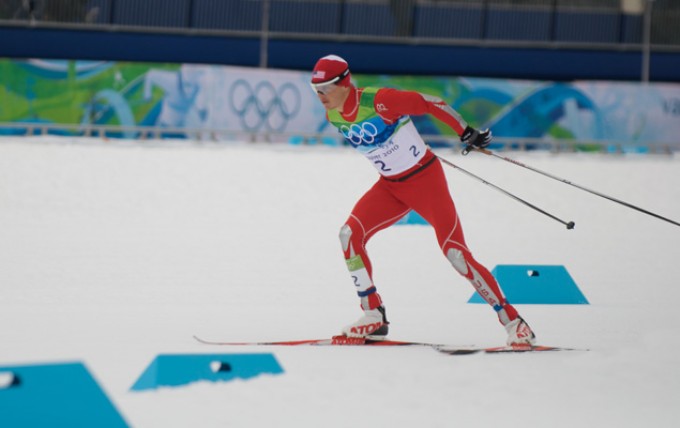
The skating – or free – technique, which was developed in the 1980s, closely resembles the motions of ice skating, where one pushes the inside edge of the ski simultaneously backward and outward at about a 45-degree angle. It usually is faster than classic technique. Since 1985 only the skating technique has been used in Nordic Combined.

Glide wax (cross-country)
Wax used to decrease the friction between the skis and the snow. It is applied to the entire ski in freestyle races, but only to the front and rear tips of the skis in classic races.

Individual Gundersen competition (cross-country)
For the Individual Gundersen competition, the jumping competition is held first, with the cross-country race being the second event. The winner of the jumping competition starts in first place first so that differences in the points from jumping are converted into time differences for the cross-country starting order.

Inrun (ski jumping)
The portion of the jump during which the athlete travels down the takeoff.

K Point (ski jumping)
The distance from the takeoff that is equivalent to the height of the hill. For a large hill, the K Point is 120 metres from the takeoff; for a normal hill, it is 90m. The K Point determines the amount of distance points awarded to a jump. A jump to the K Point is worth 60 points; each metre over or under that distance decreases of increases the score by 2.0 points on the K 90 and 1.2 points on the K 120.

Large hill (ski jumping)
The larger of the two Olympic ski jump hills, it measures 120m.

Mass start competition (cross-country)
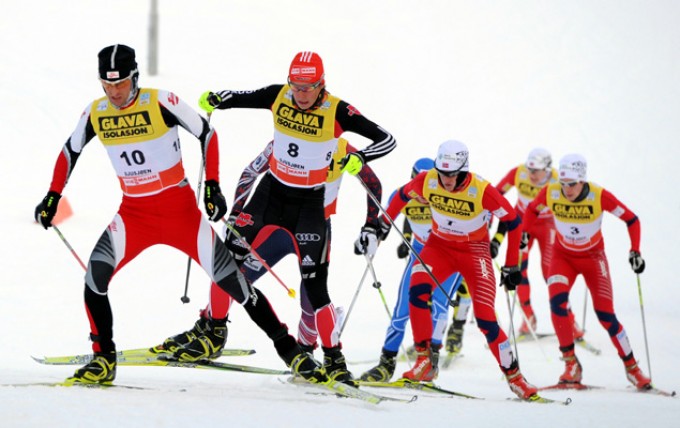
The Nordic combined mass start competition begins with a mass start cross-country race followed by a two round ski-jumping competition. The jump competition is held without the scoring of jumping style judges. The first round of the jumping competition is in reverse order of cross-country results, i.e. the winner of cross-country race gets the last start number for ski-jumping.

Normal hill (ski jumping)
The smaller of the two Olympic ski jump hills, it measures 90m.

Outrun (ski jumping)
The flat area at the bottom of the hill where skiers slow down and stop.

Takeoff (ski jumping)
At the end of the inrun, the moment where the jumper takes flight.

Telemark position (ski jumping)
Landing with one ski in front of the other, lunging forward.

V-style(ski jumping)
A ski jumping style with ski tip spread during flight to achieve optimal aerodynamic efficiency.

Source: olympic.org