
Skiing has an ancient history. The birth of modern downhill skiing is often dated to the 1850s when Norwegian legend Sondre Norheim popularised skis with curved sides, bindings with stiff heel bands made of willow, as well as the Telemark and Christiania (slalom) turns.

Ancient origins
Skiing can be traced to prehistoric times by the discovery of varying sizes and shapes of wooden planks preserved in peat bogs in Russia, Finland, Sweden and Norway. Ski fragments discovered in Russia have been carbon-dated back to circa 8000-7000 BC. It is virtually certain that a form of skiing has been an integral part of life in colder countries for thousands of years.

First competitions
Skiing changed its from a method of transportation into a sporting activity during the late 19th century. The first non-military skiing competitions are reported to have been held in the 1840s in northern and central Norway. The first national skiing competition in Norway, held in the capital Christiania (now Oslo) and won by Sondre Norheim, in 1868, is regarded as the beginning of a new era of skiing enthusiasm. A few decades later, the sport spread to the remainder of Europe and to the US, where miners held skiing competitions to entertain themselves during the winter. The first slalom competition was organised by Sir Arnold Lunn in 1922 in Mürren, Switzerland.

Olympic growth
Men’s and women’s alpine skiing both debuted on the Olympic programme in 1936 at Garmisch-Partenkirchen. The only event that year was a combined competition of both downhill and slalom. In 1948, this was held along with separate downhill and slalom races. Four years later the giant slalom was added and in 1988 the super giant slalom became a fourth separate event.

Boots
Reinforced plastic boots are specific to the competition discipline. Raising of the boot sole is permitted to increase the ability to pressurise the ski. The maximum distance between boot sole and foot is regulated, presently at 50mm for men and 45mm for women.
 
Gloves
Made of leather or synthetic material. Slalom gloves also have a plastic forearm guard for protection when skiing through the gates.
 
Goggles
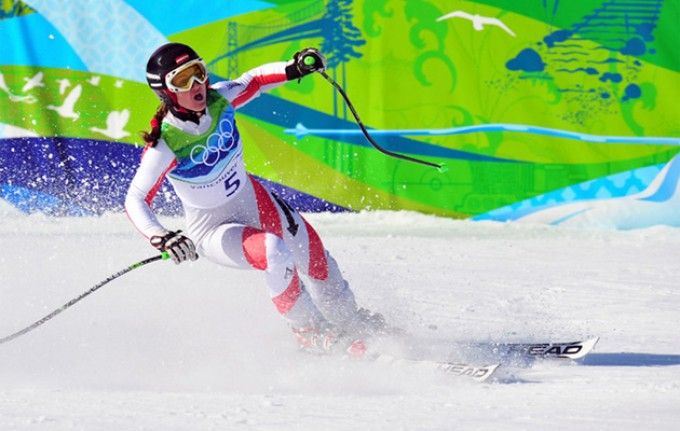
Ski goggles protect the eyes against weather, glare and the effects of speed on the eyes. Goggles can be worn with a variety of lens colours to maximise contrast and visibility.
 
Helmet
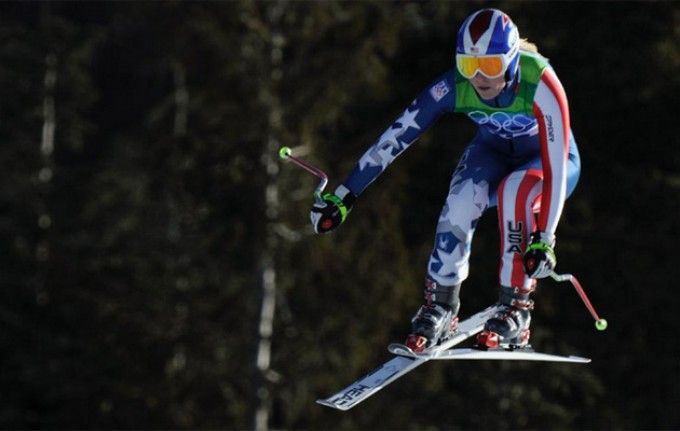
A helmet is compulsory for downhill and super-G and is often worn in slalom and giant slalom. Some skiers choose to attach a chin guard.
 
Poles
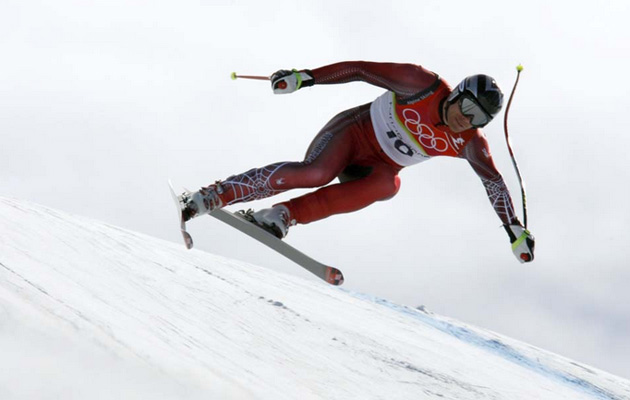
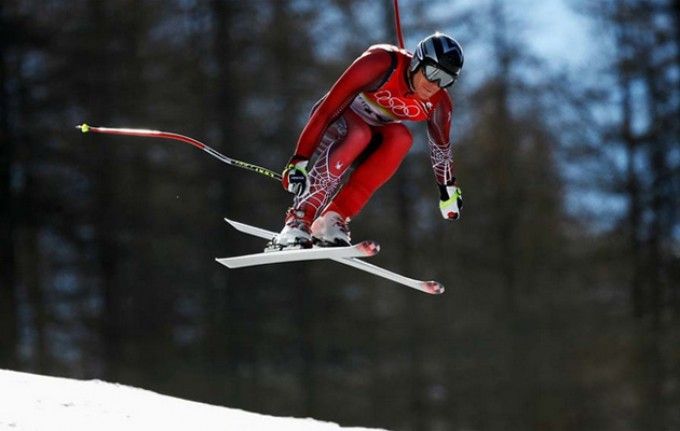
In the downhill and super-G, poles are curved to fit around the body to reduce air resistance. In the slalom events, poles are straight and often have plastic guards covering the knuckles to help skiers knock the slalom poles out of their path.
 
Skis
Skis are generally made of various material (wood, composite fibres) specially adapted to the wear and tear they undergo during a race. Their “performance” on the snow depends also on their length, width and shape which vary, depending on the course, and the speed. Metal edges on the skis are sharpened for every race to make the ski hold during the turn on the icy surface.
 
Suit
Skin-tight racing suits are worn to reduce air resistance and suits must meet minimum requirements for air permeability. Padding may be worn under the ski suit a plastic back protector is usually worn in downhill. In slalom events, pads are frequently worn on the arms, knees and shins.
Bindings
Bindings are the link between the boots and the skis. Safety bindings will release when the torsion or impact is strong enough. The maximum height (distance between the bottom of the running surface of the ski and the ski boot sole) is regulated at 55mm.
 
An equipment controller checks skis, bindings and ski boots to verify that the race equipments conforms to the rules.
 
FIS points
FIS points are used as the seeding system and are calculated from each international FIS race. The calculation system is based on a number of factors including the standard of the race based on the FIS points ranking of the participants who start and finish the race, its running time and the different race categories. In the Olympic Gamess, racers from 1-30 will be ranked according the World Cup discipline standings and racers from 30 onwards will be ranked according the FIS points
 
Gatekeeper
Gatekeepers control that the gates are passed correctly.
 
Intermediate time
Time of competitor at an intermediate point of the course: it is of the interest to those following the event but has no effect on the result.
 
Jury
The jury is tasked with the correct running of the competitions. The Jury is responsible for ensuring that competitions are run safely and in accordance with the rules
 
Start
The may start 5 seconds before and 5 seconds after the official start signal.
 
Timing
The timing clock is activated when a skier passes through a pivoting, knee-high wand to begin his or her run.
 
Video Control
The task of video controller is the same as the gatekeepers. The video controller will control that the gates are passed correctly.