Air
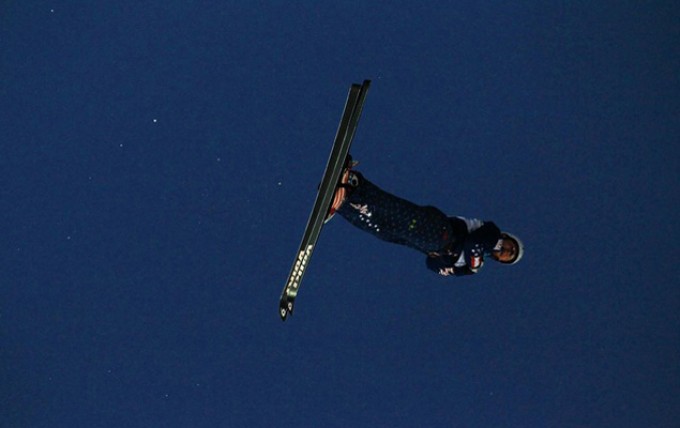
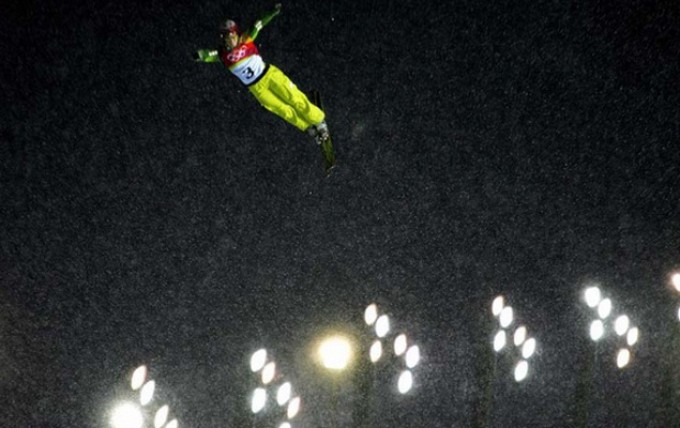
A jump in the mogul run in which the skier uses to perform jumps. Two airs are required in each moguls run.
Air Bump
A jump that has been constructed in the mogul course.
Back Full
A back flip with a full twist.
Back layout
Single flip in layout position.
Back somersault
One single backflip.
Back tuck
Single backflip in the tuck position.
Backscratcher
The skier touches his or her back with the tails of both skis. The legs are together, the knees are bent underneath the body, and the skis are parallel.
Carving
Technique of edging the skis through turns to control speed.
Control Gate
A series of 10 equally spaced gates set on the mogul course.
Cross
The crossing of the skis in an “X”.
Daffy
The skier spreads his or her legs wide apart with one in front of the body and one behind. The front ski points straight up and the back ski points straight down.
Double full
Single Layout flip with two twists.
Double full, full, full
Three flips with four twists. Two twists on the first flip, right off the jump.
Double layout or Lay-lay
Two flips in the layout position.
Double somersault
Two flips.
DSQ
Disqualification.
Fall line
An imaginary line that combines the steepest pitch and most direct line, from top to bottom, of any slope.
Flip
as Somersault, which is either performed backwards, frontwards or sideways.
Four-point landing
Both poles plant when the skier lands from a jump.
Four-point takeoff
Both poles plant as the skier takes off from the mogul.
Front somersault
One forward flip.
Front tuck
Single front flip in the tuck position.
Full
A flip with a full twist.
Full in
A full twist on the first flip of a double or triple somersault.
Full in, full out
Two flips with each flip having one twist.
Full out
A full twist on the last flip of a double or triple somersault.
Full tuck/pike
Two flips, with one twist in the first flip.
Full, double full
Two flips with three twists, with a double twist in the second flip.
Full, double full, full
Three flips with four twists. The second flip has two twists.
Full, double full, tuck
Three flips with three twists; the second flip has two twists.
Full, full, full
Three flips with three twists. Each flip has one twist.
Full, lay
Two flips in the layout position with one twist in the first flip.
Full, tuck, full
Three flips with two twists; the second flip is without a twist.
Grab
While in a jump, the skier reaches and grabs one part of the ski.
Half
A flip with a half-twist
Half in
A half-twist on the first flip of a double or triple somersault.
Half out
A full twist on the first flip of a double or triple somersault.
Half, full, half
Three flips with two twists. The first and third flips has a half twists, the second flip has full twist.
Half, half, full
Three flips. The first has a half-twist, the second has a half-twist, and the third has a full twist.
Half, rudy, full
A triple backflip, the first with a half-twist, one and a half in the second, and a full twist in the third.
Half, tuck, half
Three flips with two half-twists. Two half twists are performed in the first and third flips.
Half-half
Two flips with a half-twist in both.
Height and distance
A component of the jumping score. A term used to describe the aerialist”s flight in the air.
Helicopter
Upright aerial spin of 360 degrees.
Iron cross
Similar to a backscratcher, but the skis are crossed rather than parallel.
Kicker
Name for the jumps used in aerials.
Knoll
The line that separates the table from the landing hill.
Kosak
A combination of a spread eagle and a zudnick.
Lay, full
Double flip in the layout position with a full twist in the second flip.
Lay, full, full
A double-twisting triple flip. Twists occur in the second and third flips.
Lay, full, tuck
Triple flip, first in the layout position, second flip with a twist, third in a tuck.
Lay, lay, full
Triple flip, first two flips in layout position, third laid out with a twist.
Lay, tuck
Double flip, with the first in the layout position and the second in the tuck position.
Lay, tuck, full
A triple flip, the first in the layout position, the second in the tuck position, and the third in the layout with a twist.
Lay, tuck, tuck
A triple flip, the first in the layout position and the last two in the tuck position
Layout
Body position is extended as straight as possible.
Loop
A side flip, where the skier rotates around the central axis.
Mogul
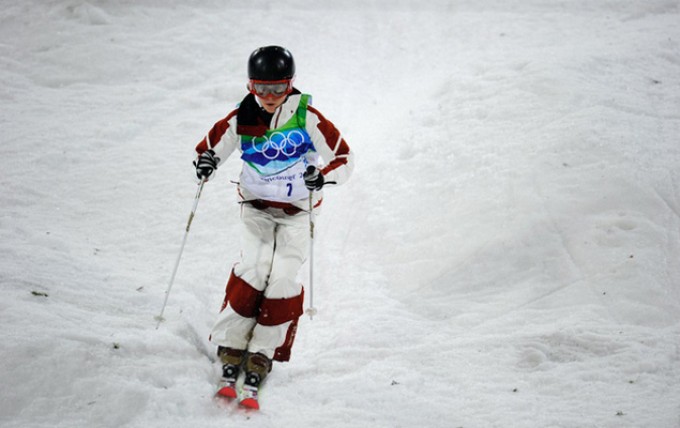
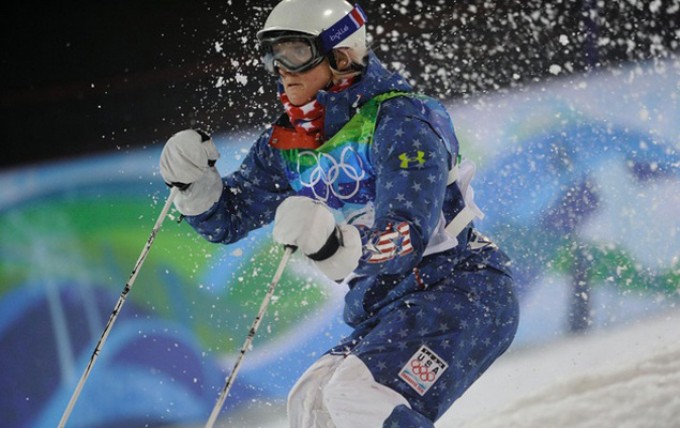
A roll or ridge of snow caused by skier traffic.
Off Axis
During the take off the skier tilts the axis of rotation. This is more commonly seen in the 360 of 720 helicopters
Pace Time
Is a calculated value which is different for men and ladies. To calculate the pace time take the course length in metres then it by the pace time value.
Pike
Jack-knifed position in which the body bends at the waist with the legs completely straight.
Pop
The body extension at the start of the jump that sets the flip in motion.
Position
A movement, which is held during jumping
Puck
Open-tuck air position with legs pulled up to 45 degrees.
Reverse trough
The technique of skiing on top of the moguls and turning in the opposite direction of the ruts.
RNS
Receives No Score.
Rudy
A flip with one and a half twists.
Ruts
The deep area between moguls.
Slapback
A poor landing in aerials, which the jumper goes to his or her back before skiing away.
Sling
A bad takeoff from the kicker when the jumper over-rotates.
Speed
The time it takes the skier to complete is worth 25% of their final score.
Spread eagle
The skier extends his or her arms and legs to the side while keeping the skis parallel and perpendicular to the body. The upper body remains straight and upright.
Table
The flat area where the jumps are built.
Takeoff
The launch of the jump.
Tip cross
Similar to the iron cross, the skier crosses the tips while remaining upright.
Trough
Deep path of ruts that runs between moguls.
Tuck
Body position in which the knees are pulled into the body.
Turns
The criteria of mogul judging, that refers to the execution of turning in moguls.
Twist
The rotation around the vertical axis.
Twister
The skier rotates his or her body the opposite way of the skis.
Zudnick
The skier leans his or her upper body toward the tips of the skis, keeping the skis close together and parallel.