Ice hockey is a fast, fluid and exciting team sport. It draws big crowds at the Olympic Games thanks to the drama and tension of the matches.
A Canadian past
Ice hockey originated in Canada in the early 19th century, based on several similar sports played in Europe, although the word “hockey” comes from the old French word “hocquet”, meaning “stick”. Around 1860, a puck was substituted for a ball, and in 1879 two McGill University students, Robertson and Smith, devised the first rules.
Stanley Cup
The first recognised team, the McGill University Hockey Club, was formed in 1880 as hockey became the Canadian national sport and spread throughout the country. In 1892 the Governor General of Canada donated the Stanley Cup, which was first won by a team representing the Montreal Amateur Athletic Association.
International growth
The sport migrated south to the United States during the 1890s, and games are known to have taken place there between Johns Hopkins and Yale Universities in 1895. Ice hockey spread to Europe around the turn of the century, and the first Olympic Games to include ice hockey for men were the 1920 Antwerp Summer Games.
Olympic history
Six-a-side men’s ice hockey has been on the programme of every edition of the Winter Games since 1924 in Chamonix. Women’s ice hockey was accepted as an Olympic sport in 1992, and made its official debut in 1998 in Nagano.
Unsurprisingly, Canada dominated the first tournaments. However, in 1956, and until its dissolution, the Soviet Union took over and became the number one team. It was interrupted only by USA victories in 1960 in Squaw Valley and in 1980 in Lake Placid.
Source: olympic.org
Elbow pads
A moulded pad that protects the elbow and elbow joint and provides forearm protection.
Goalkeepers’ equipment
Goalkeepers’ equipment includes a goalkeeper stick, goalkeeper skates, blocking glove, catching glove, helmet with full face mask and leg guards.
Gloves
The player’s gloves must cover their hand and wrist, and their palm must not be removed to permit the use of bare hands.
Helmet
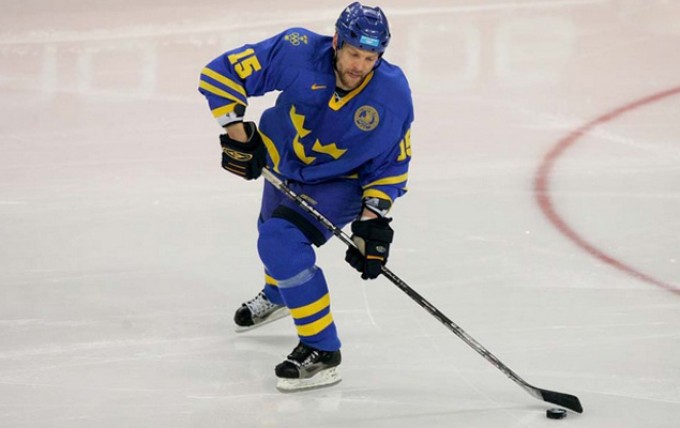
A helmet with the chinstrap properly fastened must be worn by players so that the lower edge of the helmet is not more than one finger-width above the eyebrows; there should only be enough room between the strap and the chin to insert one finger.
Puck
The puck is made of vulcanised rubber or other material approved by the International Ice Hockey Federation (IIHF) and is primarily black in colour. The puck is 2.54cm thick and 7.62cm in diameter and must weigh between 156 and 170g. It can move at speeds of more than 150km/h.
Shin guards
A device contoured and moulded to protect the shin, knee and calf.
Shoulder pad
Padding that provides extra protection for critical points of the shoulder, biceps, sternum, shoulder blade and spine.
Skates
Players must wear ice hockey skates with safety heel guards.
Stick
Sticks are made of wood or other material, such as aluminium or plastic. The stick must not have any projections and all edges must be bevelled. Adhesive non-fluorescent tape of any colour may be wrapped around the stick at any place. Sticks are prohibited from being curved more than 1.5cm.
Visor
A clear plastic shield attached to the helmet that comes down to the lower edge of the player’s nose. Male players born after 31 December 1974 must wear, at the very least, a visor that meets approved international standards. All women players must wear full face masks.
Source: olympic.org
Assist
Players are awarded assists for helping set up goals. The last two players to handle the puck prior to the scoring of the goal are usually credited for assisting the goal scorer.
Boards
The hard plastic and glass walls that surround the rink.
Body check
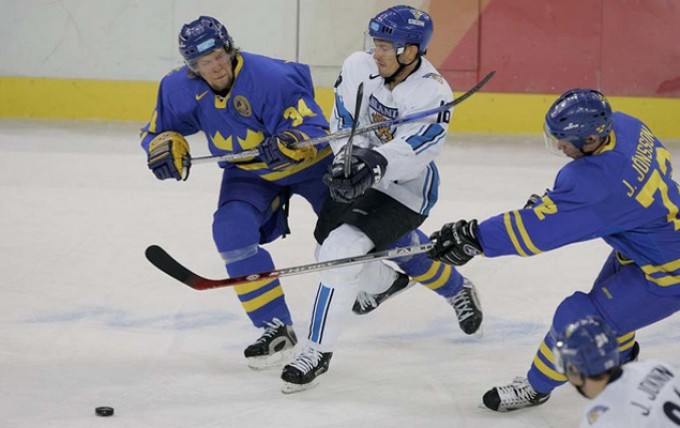
Using the hip or shoulder to impede the progress of a player or knock into a player.
Breakaway
A one-on-one scoring opportunity between the puck carrier and the opposing goalkeeper.
Butterfly pad save
A save the goalkeeper makes by dropping to his/her knees and pointing his/her toes out, creating a “V” shape with the goal pads. This style of goalkeeping is effective because of the ability to cover a larger area of the crease.
Changing on the fly
Substitution of players without a stoppage in play.
Charging
An infraction in which a player deliberately checks another player after taking more than two strides or steps.
Crease
A semicircle in front of the goal known as the goalkeeper’s privileged area. No players are allowed inside the goalkeeper’s crease. Goals are usually disallowed if a member of the opposing team is in the crease.
Face-off
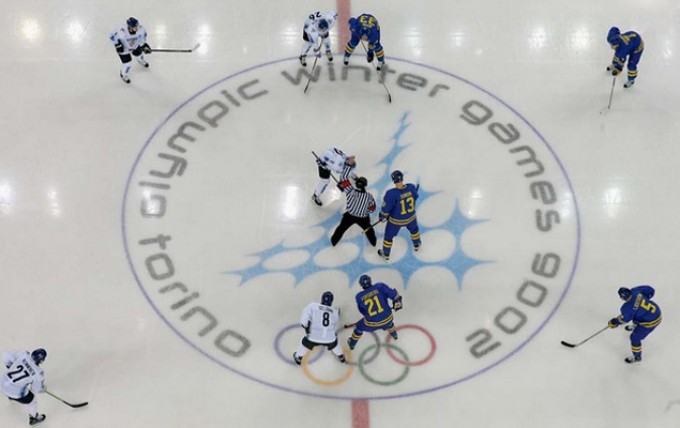
The puck is dropped between two opposing players who face each other. Face-offs occur at the beginning of each period and after any stoppage of play.
Five hole
The space in between the goalkeeper”s legs. Many goals are scored in the five hole because of the way the goalkeeper must shuffle to cover the entire net.
Forechecking
Pressuring the opposition when it controls the puck in the neutral zone or its defensive zone.
Hat trick
Three goals scored by one player in a single game.
Interference
A penalty in which a player impedes another player who does not have the puck.
Neutral zone
One of the three areas of the ice surface, the neutral zone is located between the two blue lines.
One-timer
An immediate shot off a teammate”s pass. One-timers are very effective in surprising opposing goalkeepers.
Poke check
A check in which a defender or goalkeeper uses the blade of the stick to push the puck off the stick of an opponent.
Power play
A situation in which a team has more players on the ice because of a penalty (or penalties) called against the opposing team.
Pulling the goalie
In an attempt to tie the score, a team trailing by one or two goals may take its goalkeeper off the ice and send out an extra skater. This usually occurs in the closing minutes of a game.
Short-handed
A situation in which a team is forced to play with fewer than six players because one or more have been sent to the penalty box.
Slap shot
The slap shot is the fastest of all hockey shots. Players make a sweeping motion with an accentuated backswing to shoot the puck.
Wrist shot
More of a finesse shot, players shoot when the puck is directly against the blade of the stick with a flick motion of the wrist.
Zamboni
A machine that cleans and resurfaces the ice. The zamboni is used before and after the game, as well as in between periods.

Source: olympic.org