Boarding
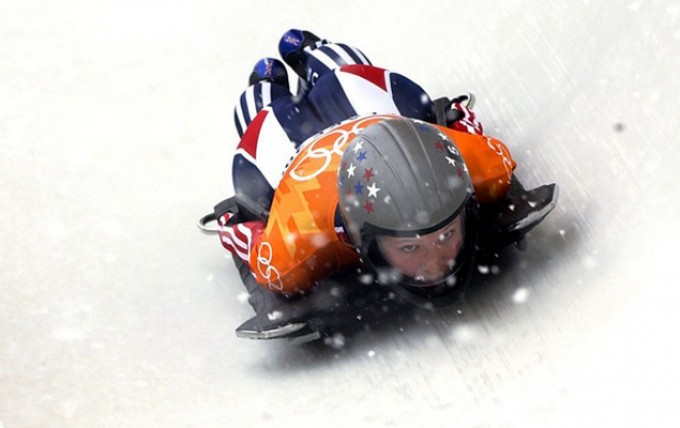
The athlete lifts his legs under his body and drops onto the skeleton in one smooth movement, avoiding loss of momentum and instability.
G-Force
Gravitational force that holds the sled and athletes on the wall of a banked turn. One “G” is equal to the force of gravity. On some tracks, the “G”-force exerted on an athlete can exceed five G’s. This would make the athlete feel as if he or she weighed more than five times their actual weight.
Hairpin bend
A very tight corner forcing the skeleton into a half turn.
Kreisel
German for circle. A curve which becomes a complete circle by crossing over itself.
Labyrinth
A stretch of track made up entirely of curves, perhaps four or five, with no straith stretch in between.
Line
The line corresponds to the optimum trajectory on the track, enabling a competitor to post the best possible time.
Lip
A safety barrier at the top of the track to prevent sleds from going off the track.
Omega
A curve which is shaped like the Greek letter of the alphabet.
Push
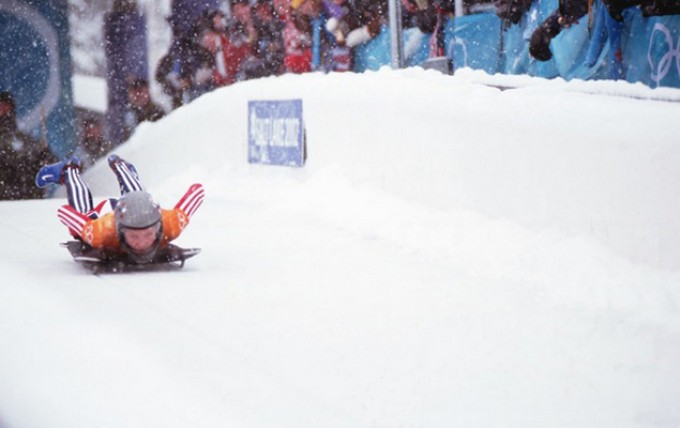
The skeleton is pushed as hard as possible over a 30-40m stretch to give it the momentum it needs.
Speed
Skeleton speeds vary between 120km/h and 135km/h.