History

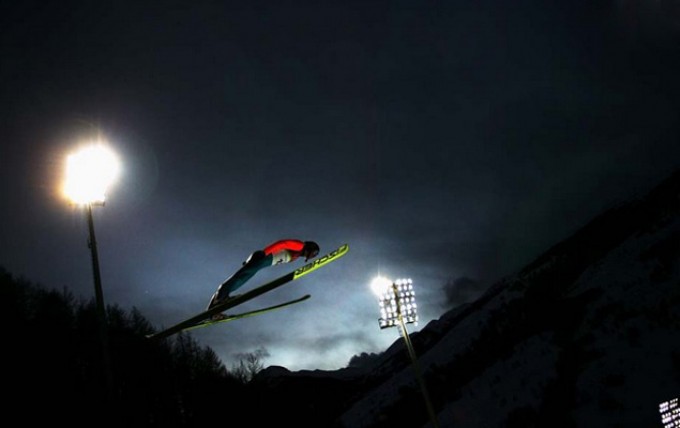
Over the past hundred years, ski jumping has evolved enormously with different jumping techniques allowing jumpers to achieve ever greater distances.

Beginnings in Norway
The origin of ski jumping can be traced to Ole Rye who jumped 9.5m in 1808. Norwegian Sondre Norheim is widely considered the father of modern ski jumping. In 1866 he won what has been described as the world’s first ski jumping competition with prizes, held at Ofte, Høydalsmo, Norway.

Early pioneers
After World War I, Thulin Thams and Sigmund Ruud developed a new jumping style known as the Kongsberger Technique. This involved jumping with the upper body bent at the hips, a wide forward lean, and with arms extended at the front with the skis parallel to each other. Using this technique Sepp Bradl of Austria became the first to jump more than 100 metres when he jumped 101 metres in 1936.

Further improvements
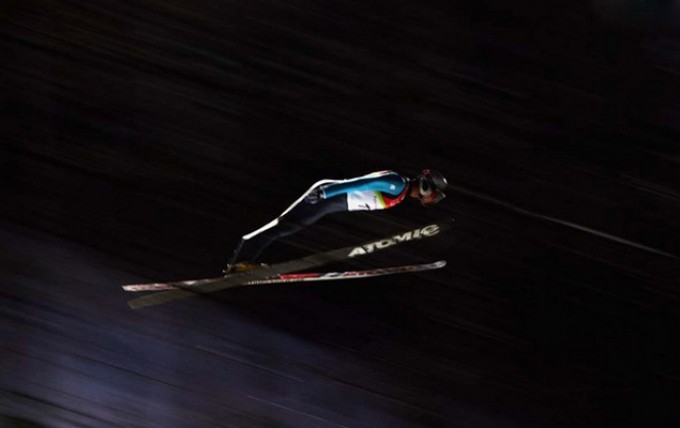
In the mid-1950s, Swiss jumper Andreas Daescher became the first jumper to hold the arms backwards close to the body with a more extreme forward lean. Then in 1985, Swedish jumper Jan Bokloev started spreading the tips of his skis into a “V” shape. Initially ridiculed, this technique proved so successful that by 1992 all Olympic medallists were using this style.

Olympic history
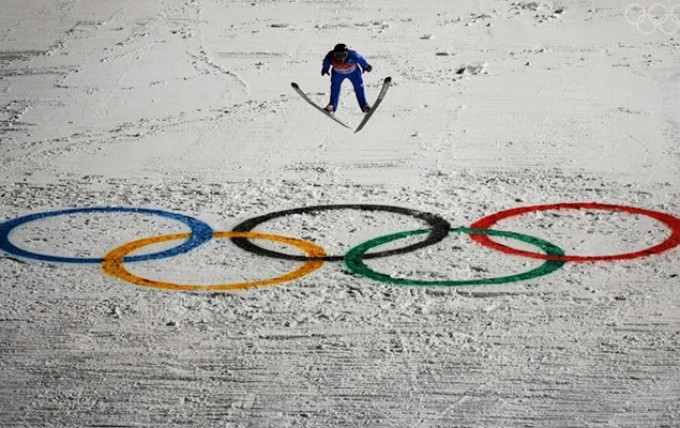
Ski jumping has been part of the Olympic Winter Games since the first Games in Chamonix Mont-Blanc in 1924. The normal hill competition was included on the Olympic programme for the 1964 Innsbruck Games. From 1988, the team event was added as a third competition.

Source: olympic.org

Equipment

Bindings
The binding must be mounted parallel to the run-direction.The binding must be placed in such a way that maximum 57% of the entire ski length is used as the front part.

Boots
High-backed, flexible yet firm boots with a low cut at the front. They are designed to allow the skier to lean forward during flight.

Connection cord
Part of the binding; a cord that attaches the ski to the boot and prevents the wobbling of skis during flight.

Ski Jumping suit
All portions of the ski jumping suit must be made of the same material and must show a certain air permeability and have a certain thickness as a maximum. The size of the suit must conform to the body shape in an upright position with certain tolerances.

Jumping skis
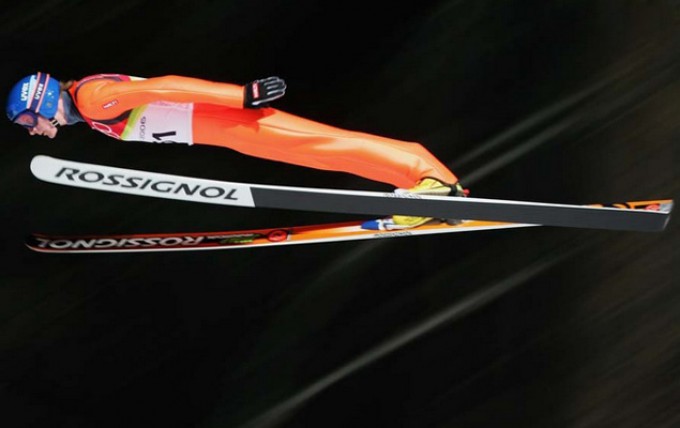
Jumping skis are manufactured especially for use on ski jumping hills. Skis with a length of maximum 146% of the total body height of the competitor can be used. The curvature and shape of the skis is restricted by certain geometric features. The jumpers need a defined body weight to be allowed to jump the maximum ski length.

Source: olympic.org

Glossary

Distance points
a jump to the K-Point obtains 60 points. For jumps shorter or longer than the K-Point, points are either subtracted or added to determine the final distance point calculation. Every metre above or below the metre value will be added or reduced by 1.8 points for large hills and 2 points for normal hills. The distance to be awarded is measured form the edge of the take-off to the athlete’s landing point on the slope, and is measured in increments of 0.5 metres.

Inrun
the inrun of a jumping hill is designed to provide the necessary speed between the starting gate and the take off.

K Point
the construction point which determines the hill size and the points calculation for the distance achieved.

Large hill
ski jumping hills with a K-point lager than 100m.

Normal hill
ski jumping hills with a K-point between 75 and 99m.

Outrun
the breaking zone at the bottom of the landing hill where skiers slow down and stop.

Style points
for a perfect jump an athlete can obtain 20 points as a maximum for a single jump. The jumping judges (five) deduct points for faults during flight, landing and outrun and subsequently, the highest and the lowest judging score is disregarded. Maximum point deduction for faults during flight is 5.0 points, during landing phase 5.0 points and out-run 7.0 points.
Example: For a jump of 125 metres on the large hill (LH), distance points are calculated as:
60.0 + (125-120) x 1.8 = 60.0 + 5×1.8 = 60.0 +9.0 =69.0
For style points: the judges score of 17.0 / 18.0 /18.5 / 19.0 / 20.0 – with the elimination of the lowest (17.0) and the highest (20.0) gives a total of 55,5 style points (18.0/18.5/19.0).
Total points = distance points + style points 124.5 = 69.0 + 55.5

Takeoff
the last 6 to 8 metres of the inrun which are straight, and at a certain angle to provide the ramp of the athletes take-off movement.

Telemark position
an artistic element of the landing performance, featuring bended knees to obtain a smooth landing and followed by a transition into the telemark position by increasing the distance between the legs and the skis. To obtain stability both arms are stretched horizontally and face upwards.

V-style
a ski jumping style with ski tip spread during flight to achieve optimal aerodynamic efficiency.

Source: olympic.org