

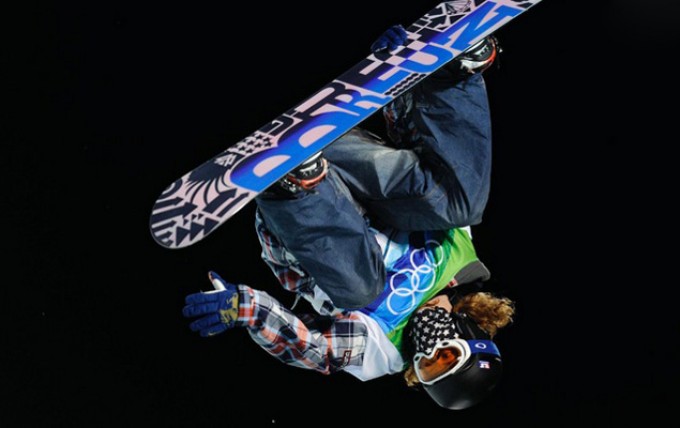
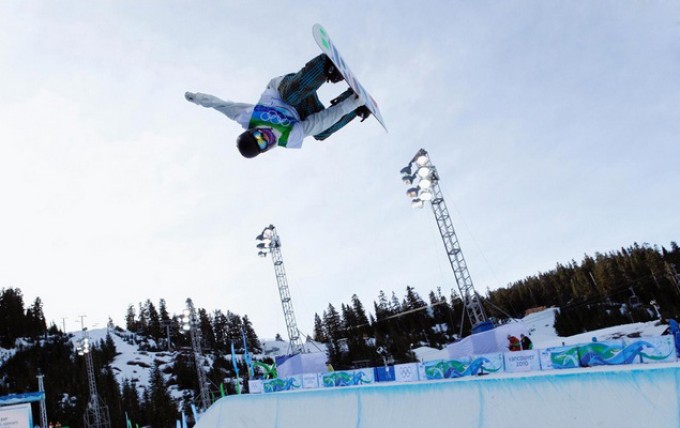
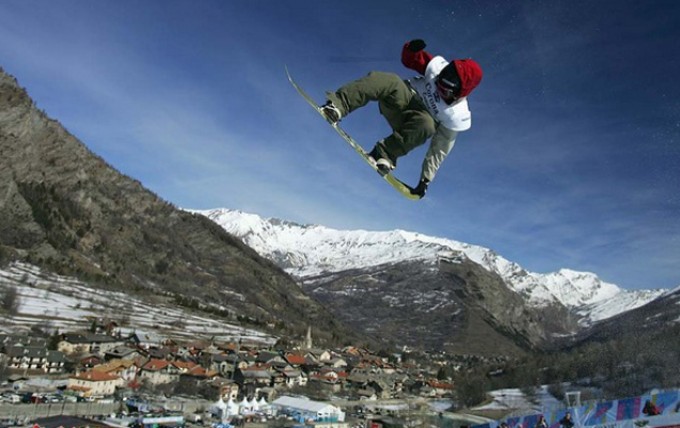
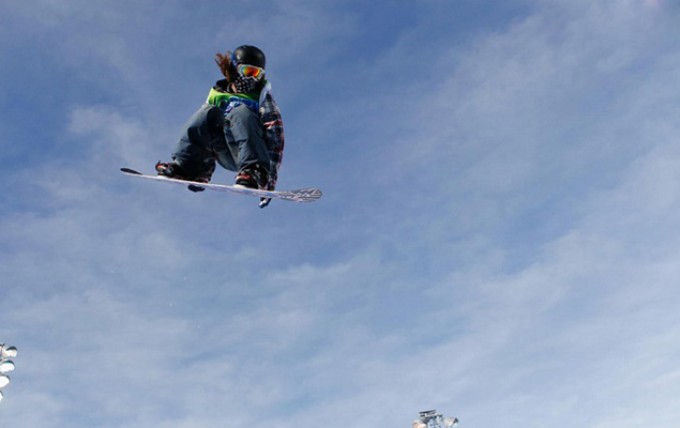


Snowboarding combines elements of surfing, skateboarding, and skiing. It made its Olympic debut at the 1998 Nagano Games.
Recent history
Snowboarding was developed in the United States in the 1960s as people across the country began to seek out new winter activities. Over the next decade, various pioneers boosted the production of boards and the sport began to gain crossover appeal. Surfers and skateboarders became involved, and by 1980, snowboarding was a nationwide activity.
Mountain conflict
In the late 1970s snowboarders started to “invade” traditional ski resorts, but faced opposition from skiers who tried to exclude the snowboarders from “their” mountains. By the 1990s, however, almost all ski resorts had accepted snowboarding, and the resorts have found the snowboarders to be an excellent source of new revenue.
Getting organised
Competition was the next logical step. The United States held its first national championships in 1982 and hosted the first World Championships in 1983. The International Snowboarding Federation (ISF) formed seven years later and the International Ski Federation (FIS) introduced snowboarding as a FIS discipline in 1994. This helped pave the way for snowboarding’s inclusion in the Olympic Winter Games.
Olympic debut
Men’s and women’s snowboarding made their Olympic debuts at the Nagano Games in 1998 with giant slalom and halfpipe competitions. The discipline proved an instant success and returned to Salt Lake City four years later with parallel giant slalom and halfpipe competitions. In Turin, snowboard cross also made its debut. In this event four riders race across a course studded with jumps, bumps and huge turns.
Source: olympic.org
Halfpipe board
A wide and flexible board is essential for balance and tricks. It allows the boarder to ride forward and backward (twin tip snowboard).
Hard boots
The boots designed for parallel giant slalom and the other Alpine events. The boots are stiff and provide good support.
Heel edge
The edge of the snowboard closest to the heels.
Helmet
A hard plastic helmet may be used in Alpine events. It is required for all competitors in snowboard-cross and halfpipe competitions.
Soft boots
Boots designed for use in freestyle and freeride snowboarding. They are made soft and pliable to allow a broad range of motions.
Alpine board
Alpine boards are stiff and narrow, which is ideal for turns and high speed.
Snowboard cross board
Designed to allow high speed, combined with a maximum of tolerance and flexibility to avoid mistakes in the jumps and obstacles.
Halfpipe boots
Halfpipe boots allow movement at the ankles to execute different manoeuvres. The rubber/urethane parts of the boots absorb shock.
Source: olympic.org
Air to fakie
Any trick in the halfpipe in which a rider approaches the wall riding forward, no rotation is made, and the rider lands riding backwards.
Alley-oop
Any manoeuvre in the halfpipe in which the rider rotates 180 degrees or more in the uphill direction.
Andrecht
A handplant using the rear hand while grabbing the board with the other (front) hand.
Backside
The side of the snowboard on which the athlete”s heels rest; the side of the snowboard to which the athlete”s back faces.
Backside air
A trick performed on the backside wall of the halfpipe, grabbing the heel edge of the board with the front hand.
Backside handplant
A manoeuvre where the rider places both hands or the rear hand on the lip of the halfpipe and rotates 180 degrees in the backside direction.
Backside rotation
Rotating clockwise for a regular-footed snowboarder or rotating counter-clockwise for a goofy-footed snowboarder.
Backside wall
If a snowboarder rides straight down the halfpipe, the side of the halfpipe that is behind the rider.
Bevel
The angle to which the edges of the snowboard are tuned. Freestyle boards have greater base-edge bevels than an Alpine board; however, Alpine boards have greater edge bevels.
Blindside
Any rotation in which the snowboarder has oriented himself “blind” to his takeoff or landing and must stretch to look over his shoulder.
Bone
To straighten out one or both legs.
Bonk
Hitting an object while riding a snowboard.
Cab
Short for caballerial.
Caballerial
Figure de halfpipe, avec début en marche arrière, rotation de 360 degrés et réception en marche avant. Porte le nom du spécialiste de planche à roulettes Steve Caballero.
Canadian bacon air
A move in which the rear hand reaches behind the rear leg to grab the toe edge between the bindings while the rear leg is straightened.
Chicken salad air
An aerial manoeuvre in which the rear hand reaches between the leg and grabs the heel edge between the bindings while the front is straightened.
Corkscrew
Sideways rotation.
Crail air
An aerial manoeuvre in which the rear hand grabs the toe edge in front of the front foot while the rear leg is straightened.
Crippler air
An aerial manoeuvre in which the snowboarder performs a 180-degree flip. The athlete approaches the wall of the halfpipe riding forward and lands riding forward.
Detune
To slightly dull the edges of the snowboard.
Double grab
Performing two separate grab tricks on one aerial.
Double-handed grab
Grabbing the snowboard with both hands on an aerial manoeuvre.
Duckfoot
A snowboard stance in which the toes point outward.
Effective edge
The part of the edge of the snowboard that is in contact with the snow; does not include the edges of the tip and tail.
Eggplant
A one-handed 180-degree backside rotated invert in which the front hand is planted on the lip of the halfpipe wall.
Elgeurial
An invert in which the halfpipe wall is approached fakie, the rear hand is planted, a 360-degree backside rotation is made, and the rider lands going forward.
Fakie
Riding backwards.
Fall line
An imaginary line that combines the steepest pitch and most direct line, from top to bottom, of any slope.
Flat bottom
The area in the halfpipe between the two walls.
Flatground
Tricks performed on a flat slope.
Flex
The stiffness of the snowboard.
Freeriding
Snowboarding for fun, not in a competition.
Freestyle snowboarding
The type of snowboarding that includes tricks; halfpipe is a type of freestyle snowboarding.
Front foot
The foot closest to the front of the snowboard.
Front hand
The hand closest to the front of the snowboard.
Frontside
The side of the snowboard on which the toes rest; the side of the snowboard the athlete”s chest faces.
Frontside air
Technically, a frontside air is an aerial performed on the frontside wall. The term also is used to describe an aerial on the frontside wall.
Frontside handplant
A manoeuvre in which the rider places the front hand on the lip of the halfpipe and rotates 180 degrees in the frontside direction.
Frontside rotation
Rotating counter-clockwise for a regular-footed snowboarder or rotating clockwise for a goofy-footed snowboarder.
Frontside wall
If a snowboarder rides straight down the halfpipe, the side of the halfpipe that is in front of the rider.
Goofy-footed
Riding a snowboard with the right foot forward.
Haaken flip
An inverted aerial in which the rider approaches the wall of the halfpipe riding backwards. At the lip of the halfpipe, the rider flips backwards into the pipe and rotates 720 degrees, landing forward down in the pipe. Named after its originator, Terje Haakonsen.
Halfpipe
The snow structure on which the halfpipe competition is contested. It is made up of two walls of the same height and size and a transition area in between.
Ho ho
Any two-hand handplant.
Indy air
An aerial manoeuvre performed on the backside wall with the rear hand grabbing the board between the bindings. “Indy” also can be used to describe the location of the grab.
International Ski Federation (FIS)
The International Ski Federation (FIS) establishes the rules, sets the schedule of events and selects the referees, judges and other officials for the Olympic Games as well as other international competitions.
Inverted 180
An aerial manoeuvre in which the snowboarder performs a 180-degree flip. The athlete approaches the wall of the halfpipe riding forward and lands riding forward. Also know as a “crippler”.
Inverted aerial
A trick in which the rider is airborne and upside-down.
Japan air
An aerial manoeuvre in which the rider grabs the toe edge in between the feet with his front hand and the front knee is pulled to the board.
J-Tear
Named after its originator, Mike Jacoby, an invert in which the athlete rotates roughly 540 degrees in a front-side direction while planting one or both hands on the lip of the wall.
Late
Incorporating a move into a trick just before the trick”s completion.
Layback handplant
A manoeuvre in which the rider places the rear hand on the lip of the halfpipe and rotates 180 degrees in the frontside direction.
Lien air
An aerial manoeuvre on the frontside wall, in which the rider grabs the heel edge with his front hand and leans over the nose of the board.
Lip
The top edge of the halfpipe wall.
Lip trick
Any trick performed on or near the lip of the wall.
McEgg
An invert in which the athlete plants the front hand on the wall, rotates 540 degrees in a backside direction and lands riding forward.
McTwist
An inverted aerial on the backside wall in which the snowboarder performs a 540-degree flip. The athlete approaches the halfpipe wall riding forward, becomes airborne, rotates 540 degrees in a backside direction while performing a front flip, and lands riding forward. Named after skateboarder Mike McGill.
Melonchollie air
An aerial manoeuvre in which the rider reaches behind the front leg with the front hand and grabs the heel edge between the bindings while the front leg is boned.
Method air
An aerial manoeuvre on the backside wall in which the rider grabs the heel edge with the front hand, bends both knees, and pulls to the level of the head.
Michaelchuck
Named after its originator, Mike Michaelchuck, an invert done on the backside wall of the halfpipe in which the rider does a backflip with a 180-degree backside rotation.
Miller flip
An invert in which the halfpipe wall is approached riding forward, the front hand is planted, a 360-degree front-side rotation is made, and the rider lands riding fakie (or backwards).
Mosquito air
An aerial trick in which the athlete reaches behind the front leg with his front hand and grabs the heel edge between the bindings. The front knee is then bent to touch the board.
Mute air
An aerial manoeuvre in which the rider grads the toe edge with his front hand either between the bindings or at the front of the board.
Nollie
A method to obtain air without jumping. It is performed by first lifting the rear foot, then lifting the front foot as the rider springs off the nose.
Nose
The front tip of the snowboard.
Nose grab air
An aerial manoeuvre in which the rider grabs the nose of the snowboard.
Nose poke air
Any manoeuvre in which you bone your front leg and “poke” the nose of the snowboard in a direction away from your body.
Nose slide
To slide along the ground solely on the nose of the snowboard.
Ollie
A method to obtain air without jumping. It is performed by first lifting the front foot, then lifting the rear foot as the rider springs off the tail.
Palmer air
Named after its originator, Shawn Palmer, an aerial manoeuvre in which the board is grabbed near the nose and pulled across the front of the body, and the nose is pointed downward.
Phillips 66
An invert in which the athlete approaches the halfpipe wall riding fakie (backwards), plants the rear hand on the lip of the halfpipe while doing a front flip, and lands in the transition area riding forward. Named after skateboarder Jeff Phillips.
Plate binding
A binding system in which hard boots are attached to the snowboard by a flat plate similar to ski bindings.
Pop tart
An aerial move in which the rider goes up fakie (backwards) and lands going forward, thus not rotating.
Rear foot
The foot mounted closest to the tail of the snowboard.
Rear hand
The trailing hand closest to the tail of the snowboard.
Regular-footed
Riding on a snowboard with the left foot forward.
Revert
To switch from riding fakie (backwards) to forward, or from forward to fakie.
Roast beef air
An aerial manoeuvre in which the rider grads the heel edge between the bindings with the rear hand and the rear leg is straightened.
Rocket air
An aerial manoeuvre in which the rider grabs the toe edge in front of the front foot with the front hand and the back leg is straightened while the board points perpendicular to the ground.
Rodeo flip
An invert in which the rider rotates diagonal over shoulder while flipping.
Rolling down the windows
A phrase used to describe when someone is caught off-balance and they rotate their arms wildly in the air to try to recover.
Sato flip
An invert done on the front-side wall of a halfpipe in which the rider does a front flip with a 180-degree rotation front-side.
Seatbelt air
An aerial manoeuvre in which the rider reaches across the body with the front hand and grabs the tail while the front leg is straightened.
Shifty air
An aerial manoeuvre in which the upper torso and lower body are twisted in opposite directions and then returned to normal. The front leg is usually straightened.
Sidecut radius
The measure of the circle”s radius to which the sidecut of the snowboard corresponds. A small radius will make for tighter turning than a large radius.
Slob air
The athlete performs a mute grab with the front hand while the back leg is boned (straightened) and the board is kept parallel to the ground.
Stalefish air
An aerial manoeuvre in which the athlete grabs the heel edge behind the rear leg in between with the rear hand, while the rear leg is boned (straightened).
Stance
The position of the feet on the snowboard.
Step-in binding
Binding system in which no major manual adjustment is needed to attach and detach the boot from the binding.
Stiffy air
Any aerial in which both legs are boned (straightened) and a grab is done.
Switchstance
Performing a trick while riding backwards when the manoeuvre is performed exactly like it would be if you were riding forward.
Tail
The rear tip of the snowboard.
Tail grab air
The athlete grabs the tail of the snowboard with the rear hand.
Tail poke
Any manoeuvre in which you bone (straighten) your rear leg and “poke” the tail of the snowboard in a direction away from the body.
Tail slide
To slide along the ground solely on the tail of the snowboard.
Tail wheelie
To ride solely on the tail of the snowboard with the nose in the air.
Taipan air
An aerial manoeuvre in which the athlete reaches behind the front foot and grabs the toe edge between the bindings with the front hand. The front knee is then bent to touch the board.
Toe edge
The edge of the snowboard on which the toes rest.
Tranny
A slang term for transition.
Transition
The curved surface of the halfpipe walls between the flat section and the vertical portion of the wall.
Traverse
To ride perpendicular to the fall line; to ride across the halfpipe.
Tuck knee
A technique in which one knee is bent and the ankle is bent sideways to touch the knee to the snowboard between the bindings.
Twin tip
A type of snowboard used in freestyle. It has an identical tip and tail so the board can be ridden in either direction.
Vertical
The top portion of the wall in a halfpipe that allows the snowboard to fly straight up in the air.
Wet cat
An inverted aerial in which the athlete plants the front hand on the wall, rotates 900 degrees in a backside direction and lands riding forward. It is a 900-degree McTwist.
Source: olympic.org