

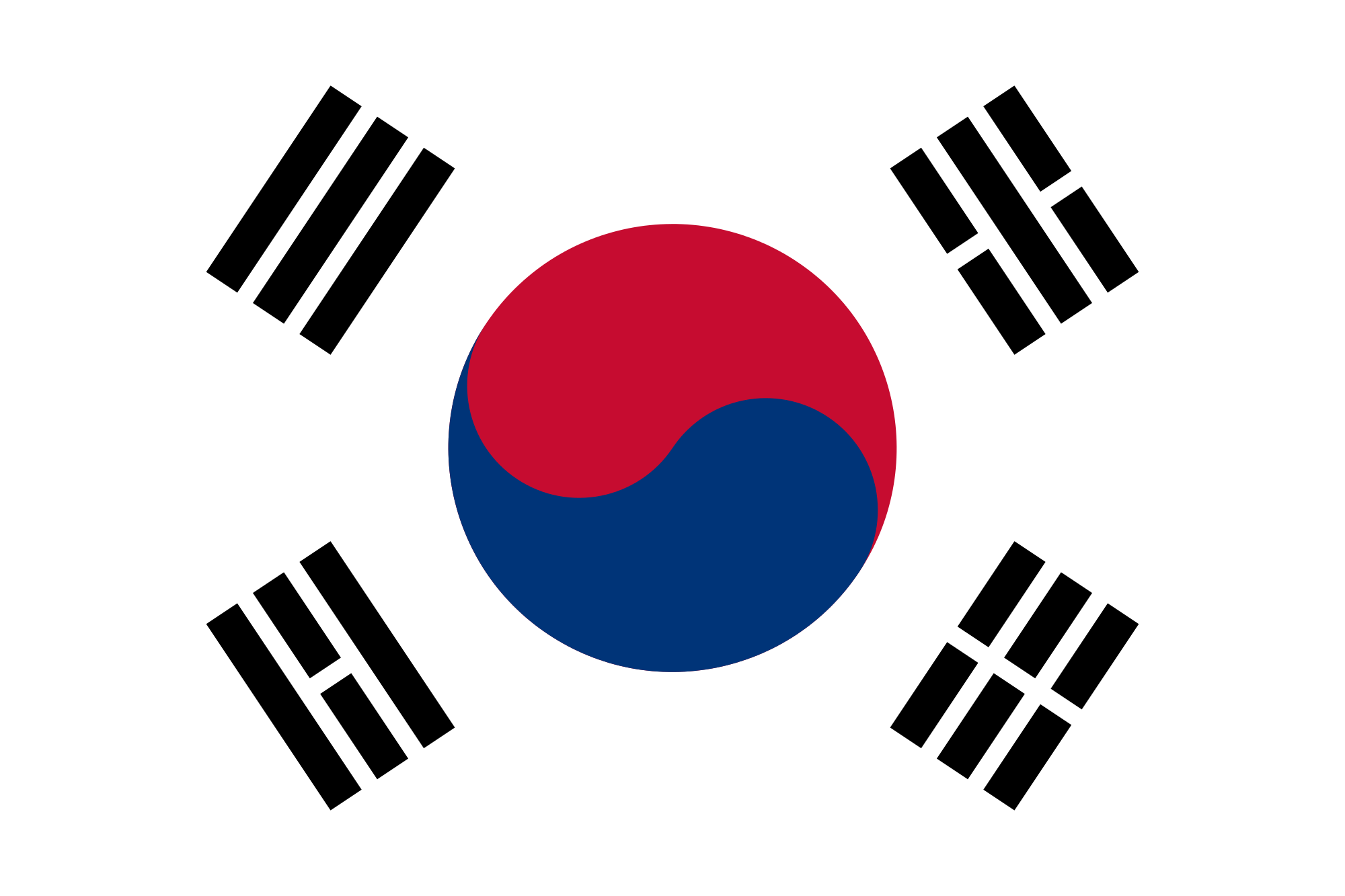
Unlike other countries, which use dark colors and complex designs to create their flags, the Korean national flag consists of simple colors and concise patterns – a white background, yin and yang symbols of red and blue, and four of the Eight Diagrams. In Korea, it is also called Taegeukgi.
The flag has been used since 1883, later period of Chosun Dynasty, and in 1949, the Ministry of Culture and Education in Korea confirmed the design of Korean national flag that we see today. As the official explanation says, blue is traditionally used to represent yin, and red represents yang. The unity of yin and yang means the harmony in the universe. Fire and water, brightness and darkness, male and female are all connected with yin and yang, the two greatest powers in the universe which keep balance by being mutually contradictory.
Around the yin and yang symbols, there are four of the Eight Diagrams on the four corners respectively. These diagrams were inspired by The Book of Changes written in ancient China, which covers many astronomical phenomena and uses Hexagrams to explore the universe. The four diagrams on the Korean national flag are named Qian, Kun, Kan, and Li. Qian represents heaven, Kun represents earth, Kan represents the moon and water, and Li represents the sun and fire. You can also see the yin and yang relationship through this.
The white background has its own meanings as well. As we all know, Koreans are extremely patriotic, and it is understandable that they use white to represent their holy land and to show their belief that every generation living on this land is kind and pure.
There are some days on which the flag is proudly displayed nearly everywhere. New Year’s Day is one, and Gwangbokjeol, Holy Trinity, and Gaecheonjeol are the others. Like other countries, Koreans hang their flag at half-mast during times of mourning and memorial.